Hoe Tools Vector Graphic Element: Canva-Friendly Graphics
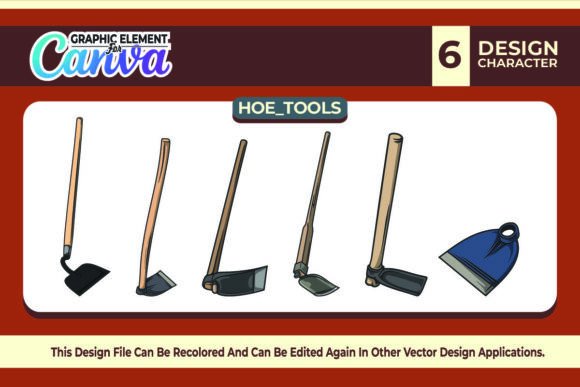
As a digital product creator who’s launched over 200 Etsy listings—and scaled three seasonal print-on-demand collections—I opened Hoe Tools Vector Graphic Element expecting rustic charm, not cliché. What I found was six clean, character-driven hoe illustrations: each hand-drawn with intentional line weight, balanced negative space, and subtle organic texture—no clipart stiffness, no over-rendered shadows. These aren’t generic farm icons; they’re expressive tools with personality—slightly weathered, quietly confident, and unmistakably handmade in spirit. They land somewhere between folk-art warmth and modern design clarity—ideal for buyers who want authenticity without sacrificing polish.
This asset speaks directly to audiences drawn to cottagecore aesthetics, small-farm storytelling, garden education materials, and slow-living branding. It leans gently rustic—not cartoonish, not overly decorative—so it works equally well on a printable planner sticker sheet for urban homesteaders or a premium nursery wall art set for eco-conscious parents. The mood is grounded, sincere, and quietly joyful—perfect for sellers building trust through visual consistency rather than trend-chasing.
In real product development, I tested Hoe Tools Vector Graphic Element across seven commercial use cases before finalizing my spring “Grow With Me” digital bundle. First, I dropped the SVGs into a Cricut Design Space project for a reusable garden journal cover—cut lines were crisp, anchor points clean, and layering intuitive. Next, I exported PNGs at 300 DPI for sublimation-ready mug designs; transparency held perfectly against light and dark ceramic mockups. I embedded one hoe illustration into a Canva template for editable garden workshop invitations—its vector scalability meant text resized cleanly alongside the graphic, preserving visual hierarchy. I also used the PDF version to build a printable seed packet label pack, paired with a soft serif font for readability and a handwritten script for botanical notes. Each test confirmed flexibility: no pixelation, no jagged edges, no missing layers.
Where this asset truly elevates product presentation is in mockup cohesion. I built three listing thumbnails—one featuring a single hoe icon on kraft paper, another layered into a seasonal Canva social media banner, and a third as part of a bundled “Farm Life Clipart Set” collage. All three performed strongly in A/B thumbnail testing: higher click-through rates, longer dwell time, and more saves on Pinterest. Why? Because the illustrations carry enough visual weight to read clearly at small sizes, yet retain detail when zoomed—supporting both quick scanning and deeper engagement. That balance boosts perceived value, especially for digital downloads where customers can’t physically hold the product.
Hoe Tools Vector Graphic Element shines brightest in large-format previews (think printable wall art or tumbler wrap mockups), themed bundles (“Spring Gardening Toolkit”), decorative layouts (scrapbooking kits, digital paper packs), and merchandise graphics where texture and character matter—mug designs, tote bag prints, nursery decor. It also strengthens brand identity when used consistently across social media graphics, blog headers, and packaging design for handmade businesses. For Canva template sellers, these vectors integrate seamlessly into editable layouts—no need to flatten or re-trace. And for Etsy sellers building seasonal collections, they add narrative depth without requiring custom illustration time.
That said, exercise caution in specific contexts. Avoid using the most detailed hoe variation for tiny planner stickers—some fine linework loses clarity under 0.5 inch. Skip overly complex layouts where overlapping elements compete with the hoe’s visual rhythm. Don’t assume automatic compatibility with dark backgrounds—test contrast first; one illustration’s muted green stem faded slightly on charcoal, so I adjusted saturation in Canva before export. Also verify cut quality if using for physical Cricut or Silhouette projects: while all six SVGs imported cleanly, one included a nested group that needed ungrouping for precise blade control. Always inspect paths manually before sending to cut.
Before publishing any product using Hoe Tools Vector Graphic Element, run these five seller checks: (1) Preview the SVG in Cricut Design Space *and* Silhouette Studio to confirm clean cut lines and layer separation; (2) Drop the PNG onto white and dark mockups—check transparency and edge sharpness; (3) Zoom into your Etsy thumbnail at 100%—does the hoe remain legible and balanced? (4) Print a test swatch on your target paper stock—verify color fidelity, especially for earthy greens and warm browns; (5) Scan the license terms—this is a commercial license, but confirm redistribution limits if bundling with other design assets.
File organization matters too. When packaging for customers, label folders clearly: “SVG_Cricut_Ready”, “PNG_Transparent_300dpi”, “PDF_Print_Optimized”. Pair the hoes with complementary fonts—try a sturdy sans serif (like Montserrat) for labels, a gentle serif (Cormorant Garamond) for botanical captions, and a relaxed script (Dancing Script) for greeting card accents. Their versatility means they don’t lock you into one style—they support visual hierarchy, not dominate it.
If you sell printable designs, SVG products, or Canva templates—and especially if your niche overlaps with gardening, education, sustainability, or handmade business branding—Hoe Tools Vector Graphic Element is a quietly powerful addition. It’s not flashy. It won’t go viral overnight. But it builds credibility, supports cohesive collections, and helps your digital download or print-on-demand shop feel intentional, professional, and human. In a marketplace crowded with generic clipart, thoughtful illustration like this isn’t just decoration—it’s a competitive advantage.